

SUMO software
It is open-source microscopic traffic simulation software used to model and analyze road traffic, vehicles, pedestrians, traffic signals, and transportation networks.
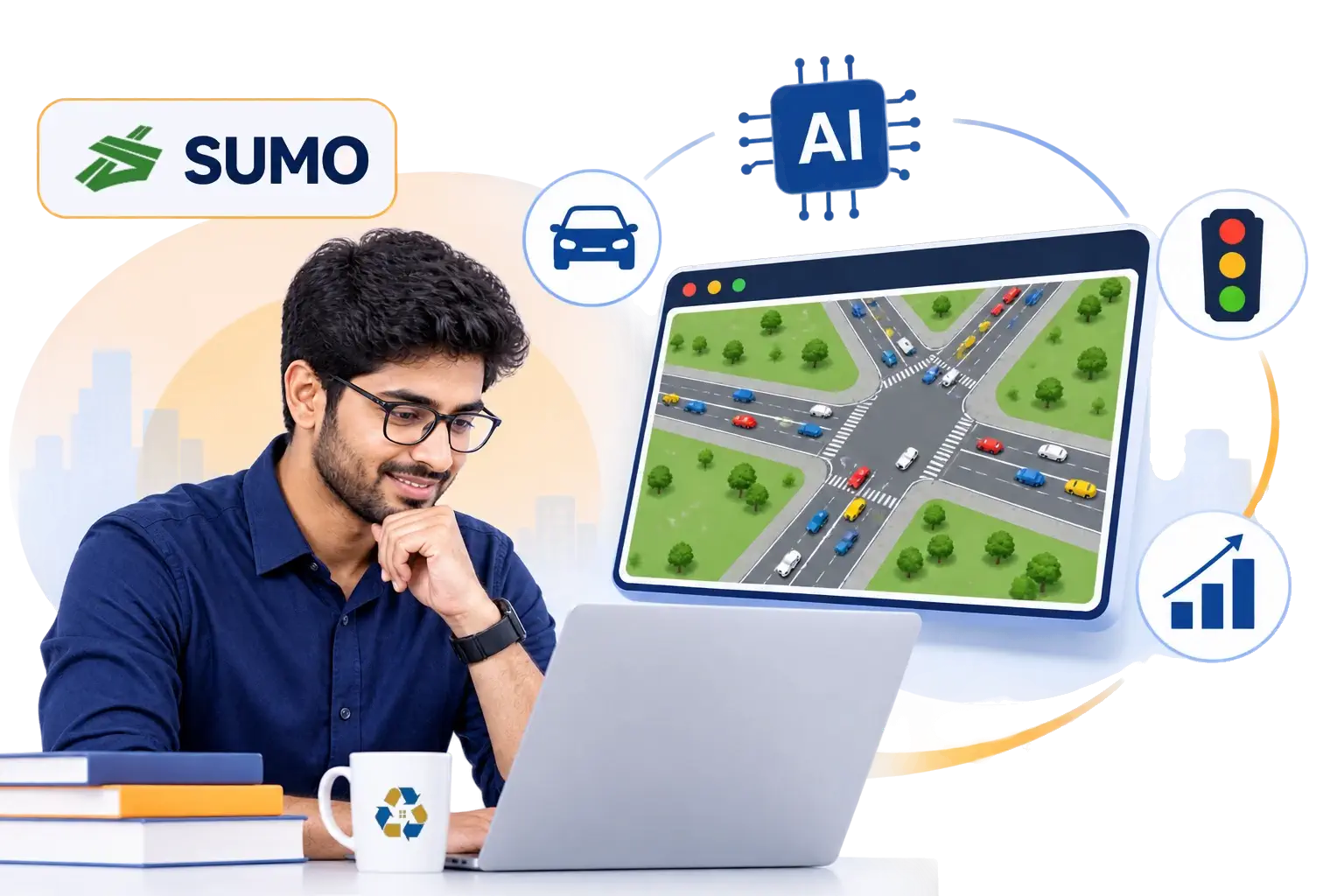
What can SUMO (Simulation of Urban MObility) software do?
Traffic flow simulation
Road network modelling
Traffic signal simulation
Public transport simulation
Connected & autonomous vehicle
Emission analysis
Traffic data analysis
Integration with Python
SUMO for PhD/ Research projects
SUMO is particularly useful for research involving
SUMO Implementation Services by HIGS
Custom SUMO implementation support built for your research, spanning network modelling, traffic demand generation, and dynamic script control.
1. SUMO Installation & Configuration
We assist scholars with the installation, configuration, environment setup, and initial testing of SUMO according to their research requirements.
2. SUMO Traffic Network Creation
Our implementation support can include the development or configuration of:
- Roads
- Lanes
- Junctions
- Traffic signals
- Vehicle routes
- Traffic demand
- Network connections
3. SUMO Python Integration
For research projects requiring programming-based simulation control, SUMO can be integrated with Python. We can assist with research-oriented Python and SUMO integration, including simulation control and data extraction.
4. TraCI Implementation
TraCI (Traffic Control Interface) enables external applications to interact with a running SUMO simulation.
Researchers can use TraCI-based implementations for:
- Dynamic traffic control
- Vehicle monitoring
- Route modification
- Traffic signal control
- Simulation parameter changes
- Algorithm evaluation
- Real-time simulation interaction
5. Traffic Optimization
SUMO can be used to investigate approaches for:
- Traffic congestion reduction
- Route optimization
- Signal optimization
- Travel-time reduction
- Traffic-flow improvement
- Intelligent traffic management
SUMO for AI & Machine Learning Research
SUMO can also serve as a simulation environment for Artificial Intelligence and Machine Learning-based transportation research.

Researchers can use simulated traffic data to investigate approaches such as:
- Machine learning-based traffic prediction
- Deep learning for traffic flow analysis
- Reinforcement learning for traffic signal control
- AI-based route optimization
- Intelligent vehicle control
- Congestion prediction
- Multi-agent traffic optimization
- Autonomous driving research
HIGS can assist scholars in developing SUMO simulation environments suitable for AI/ML-based research experiments.
SUMO Research Project Workflow
Research Problem
Research Objective & Methodology
SUMO Network Development
Traffic & Vehicle Configuration
Simulation Scenario Creation
Algorithm / Model Implementation
SUMO–Python / TraCI Integration
Simulation Execution
Data Collection
Performance Evaluation
Graphs & Research Results
GET SUMO IMPLEMENTATION SUPPORT- DOWNLOAD PRICE QUOTE NOW
SUMO for Intelligent Transportation Systems
Researchers can simulate different transportation conditions and evaluate how an intelligent system responds to changes in traffic flow, vehicle density, routes, signals, or network conditions. This makes SUMO useful for research in smart transportation, intelligent mobility, connected vehicles, V2X communication, traffic management, and smart-city infrastructure.
SUMO for Autonomous Vehicle Research
SUMO can be incorporated into research involving connected and autonomous transportation systems.
Possible research scenarios include:
- ✓ Autonomous vehicle movement
- ✓ Vehicle-following models
- ✓ Lane-changing behavior
- ✓ Route selection
- ✓ Traffic interaction
- ✓ Connected vehicle scenarios
- ✓ Mixed traffic environments
- ✓ Autonomous traffic management
- ✓ Vehicle-to-Infrastructure research
Researchers can create simulation scenarios and evaluate proposed approaches under different traffic conditions.
What Can Be Evaluated Using SUMO?
Depending on the research objective, simulation experiments can examine metrics such as:
Average travel time
Vehicle waiting time
Vehicle speed
Traffic flow
Vehicle density
Queue length
Number of stops
Network throughput
Route performance
Congestion levels
Fuel consumption
Vehicle emissions
Researchers can compare these metrics across different simulation scenarios to evaluate their proposed methodology.
Start Your SUMO Research Implementation
Working on a SUMO-based PhD project or transportation research problem? Share your research objective, methodology, or implementation requirement with our team.
Our experts can help you plan the appropriate SUMO simulation, Python/TraCI integration, AI model implementation, and experimental workflow for your research project.
Why Choose HIGS for SUMO Implementation?
Research-Focused Implementation
We understand that a SUMO implementation is usually part of a larger PhD research methodology.
Technical Implementation Support
Get assistance with SUMO, Python, TraCI, simulation configuration, and research model integration.
AI & ML Integration
Build simulation workflows involving machine learning, deep learning, reinforcement learning, and intelligent transportation algorithms.
Customized Simulation Support
The simulation environment can be structured around the scholar's research objectives rather than using a generic setup.
Programming & Simulation Assistance
Support can combine SUMO with programming and research tools where required.
Customized Research Models
Implementation can be structured around the specific problem, dataset, parameters, and methodology of your research.
Result-Oriented Simulation
Generate meaningful simulation outputs that can support analysis, comparison, and research evaluation.
PhD Research Assistance
Our support is designed for scholars working on dissertations, journal articles, conference papers, and academic research projects.
Technical Troubleshooting
Get assistance with simulation configuration, implementation issues, scripts, errors, and debugging.
Who Can Use Our SUMO Implementation Support?
Our SUMO assistance is suitable for:
Working on transportation, AI, IoT, smart-city, networking, or mobility research.
Developing simulation-based methodologies and experimental models.
Working on traffic simulation and intelligent transportation projects.
Conducting simulation-based transportation and mobility studies.
Developing experimental environments for transportation-related research.
Using SUMO to model roads, intersections, traffic flows, vehicle movements, congestion, and transportation networks.
Simulating urban mobility, intelligent traffic management, connected transportation, and smart-city scenarios.
Implementing SUMO with Python and AI/ML techniques for traffic prediction, optimization, reinforcement learning, and intelligent decision-making.
Developing connected transportation models involving sensors, real-time traffic data, vehicle communication, and intelligent mobility systems.
Studying autonomous driving scenarios, vehicle behaviour, routing, traffic interactions, and connected vehicle environments.
Simulating EV mobility, vehicle routes, charging-related traffic scenarios, energy consumption, and sustainable transportation systems.
Using SUMO mobility traces for VANET, V2X, 5G/6G, wireless communication, and network simulation research.